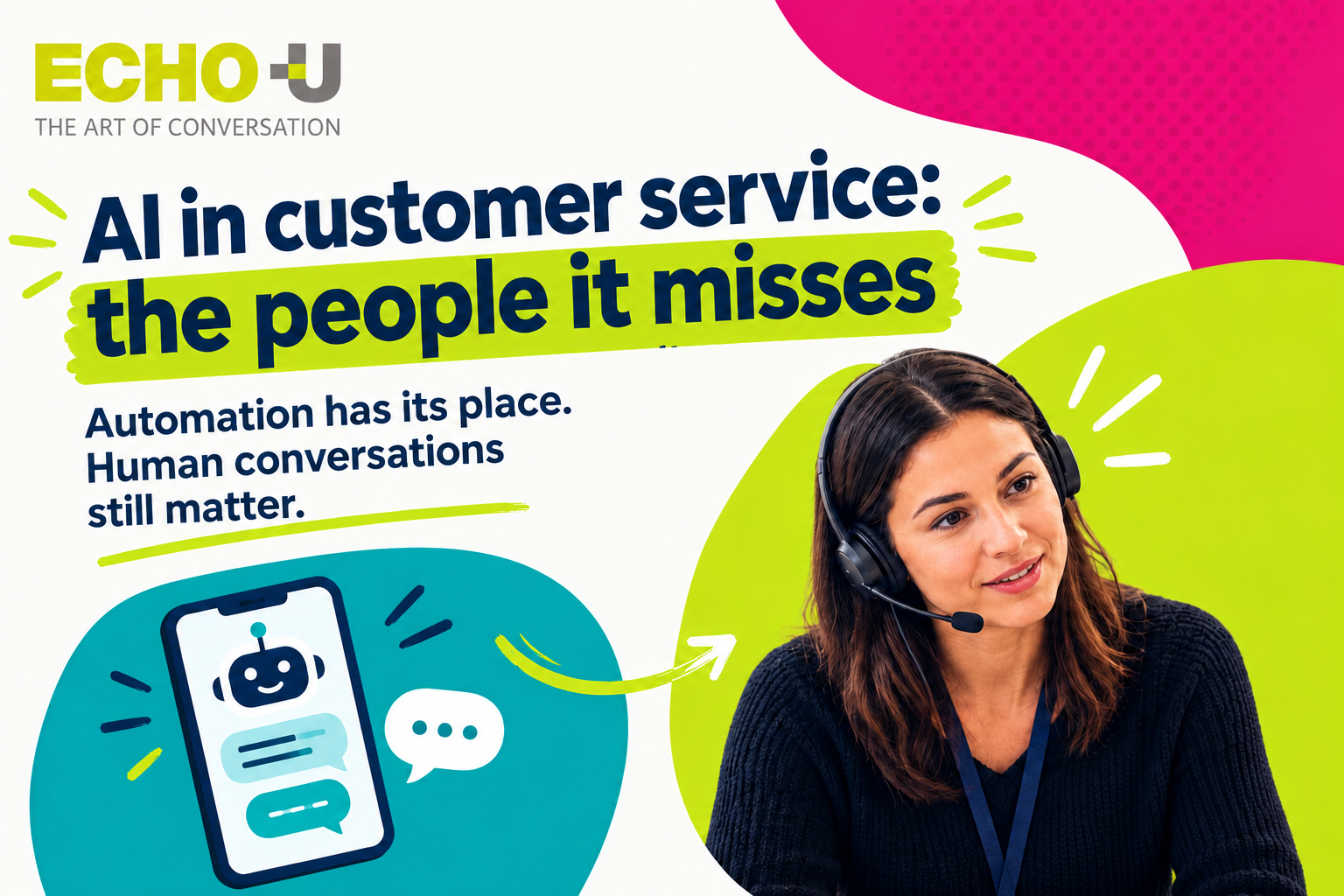
AI is everywhere in customer service and customer support now. Chatbots answer questions at midnight, automated texts confirm deliveries, and online forms deal with things that used to need a phone call. Most of the time it works well, and for the people it works for, it’s quicker and easier than waiting in a queue. But there’s a group of people it doesn’t work for, and they tend to be the ones who need help the most, including many vulnerable customers.
The easy majority
Every organisation has a big chunk of customers with simple needs. They want to track an order, update their address, book an appointment or check a balance, and they’re happy to do it on a screen. Automation and self-service are great for them, and we’d never argue otherwise.
Then there’s everyone else. People who don’t have access to the technology in the first place. People who aren’t confident online, who struggle with reading, or who have English as a second language. People who don’t trust an automated message from a number they don’t know. People dealing with something difficult at home, who need someone to listen before they’ll explain what’s really going on. They don’t fit neatly into a menu, and when they hit a chatbot, a lot of them just give up.
When the automated options run out
By the time most people pick up the phone, they’ve already tried the chatbot, the FAQs and the online form. What they need at that point is a real voice. The customer who can’t get past a chatbot to report a problem. The customer who’s been let down and wants to know someone has actually heard them. These are often an organisation’s most vulnerable customers, and they’re the ones automation tends to serve worst. Good customer support means making sure they can still reach a person when they need one.
An example from our work: NEET and destination tracking
Some of our own work is a good example of this. We support local authorities with NEET and destination tracking, which councils have a legal duty to carry out. They need to know whether the 16 to 24-year-olds in their area are in education, employment or training, so they can support the ones who aren’t. Most young people are picked up through data from schools, colleges and training providers, and texts and online forms confirm plenty more. That’s technology doing what it’s good at.
The ones left over are different. They haven’t replied to the texts. Their number has changed, or the one on file belongs to a parent. Some won’t pick up during the day but will answer on a Tuesday evening or a Saturday morning. And when our UK-based advisers do get hold of them, the first answer is rarely the full story. Ask a few more questions and it comes out: a course that wasn’t right for them, looking after a family member, anxiety, not being able to afford the bus fare to college. Often it’s a mix.
A form can record that someone is NEET, but it can’t find out why. It can’t hear that someone sounds low, or pick up on what they’re not quite saying. A conversation can, and that’s what gets a young person referred to the right team at the council and supported back into education, employment or training, rather than staying a line on a spreadsheet.
Where we think AI belongs
We’re not against AI, and we use it ourselves. For a while now our advisers have used it behind the scenes for note-taking and pulling information together from different systems. It cuts down the admin, so more of their time goes on actually talking to people. We’ve written before about our early experience of using AI , and about how people and automation worked together on a university student recruitment campaign.
That feels like the right way round to us. Let technology handle the simple stuff and the admin, and make sure there’s a real person there for everyone it can’t help. As a UK-based contact centre providing outsourced customer service and customer support across phone, live chat, email and social media, that’s how we work with every client.
If you’re working out where that line sits in your own organisation, or how best to reach your more vulnerable or disengaged customers, we’d be happy to have a chat. Drop us a line at info@echo-u.co.uk.
Meta description: AI is great for simple tasks, but some people need a real conversation. Why UK-based customer support matters more than ever.